Saturday, 31 October 2009
Aimee Brodeur
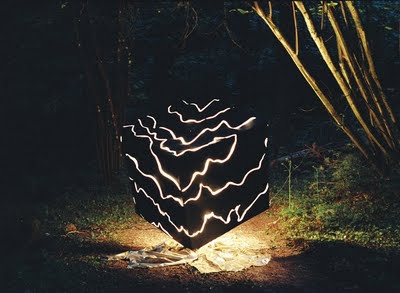
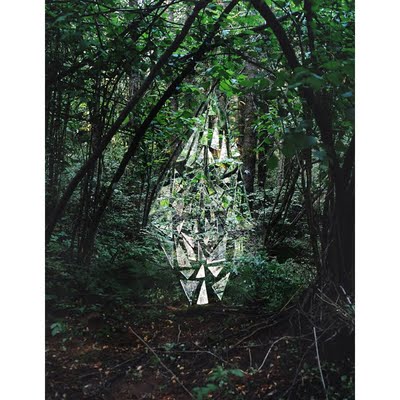
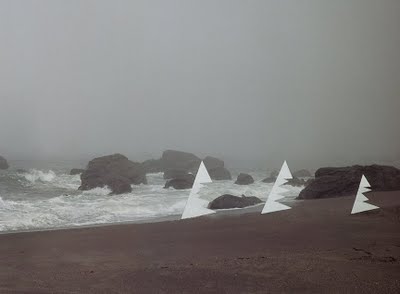
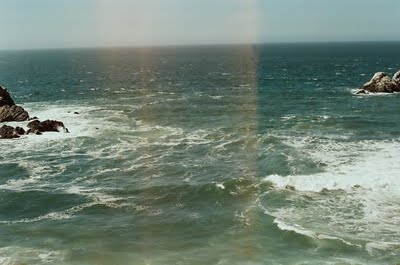
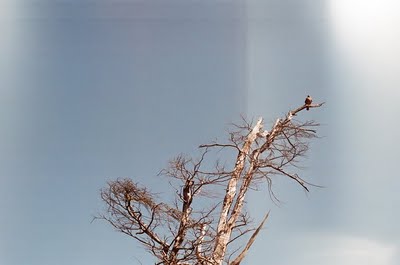
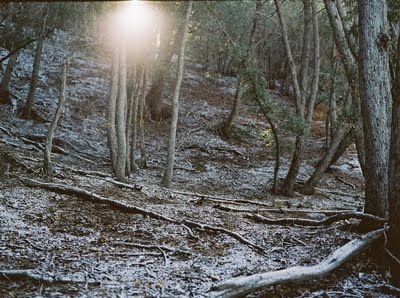
Work from Sculptures and Diary.
There was no text to be found about this work, but they function so well as photo sculptures I wanted to share them. I am particularly drawn to the process errors in these works as an aesthetic, but I am not sure if their intent moves beyond that. However, given the nature of the photo-sculptures I think that there are some meta-photographic conceptual interests at play as well.
Tags: color, error, meta-photography, photo sculpture, photography, process, stain
Posted in color, error, meta-photography, photo sculpture, photography, process, stain | No Comments »
Friday, 30 October 2009

Sally McKay
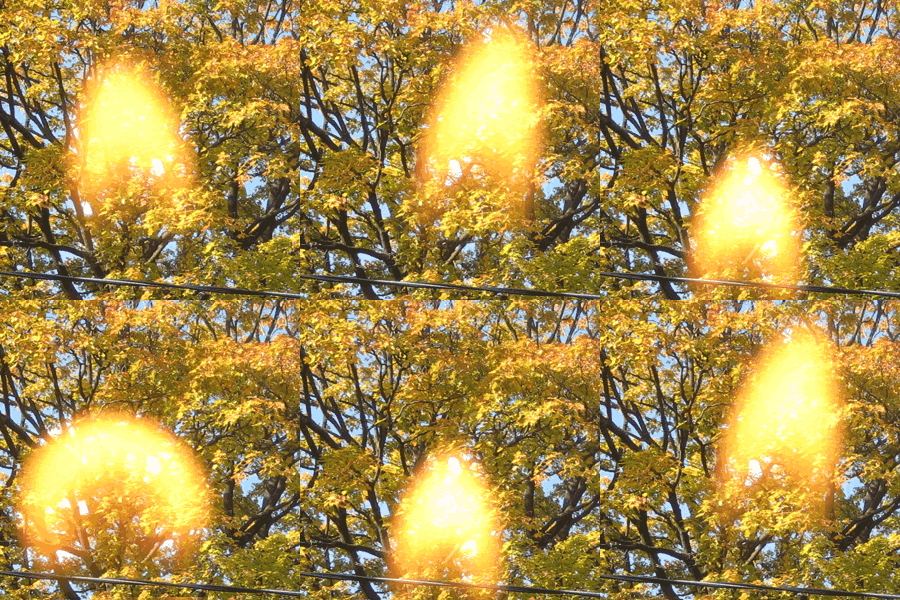
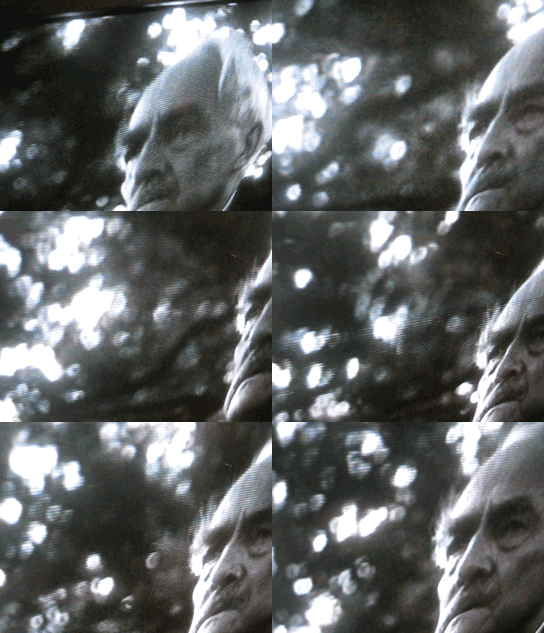
Work from Animated GIFs.
Excerpt from The Affect of Animated GIFs (Tom Moody, Petra Cortright, Lorna Mills)
“Since the early days of internet art, online artists have participated in challenging the museum and gallery hierarchies of off-line art systems.[9] The vast majority of GIFs (as well as YouTube videos, Flash animations, RealAudio sound files and a host of other cultural digital formats) are used by creative producers who do not self-identify as artists. Animated GIFs are created, collected and displayed by everyone from Christian website designers,[10] to antique technology buffs,[11] to culture bloggers.[12] For online artists, then, the use of the animated GIF also demonstrates a willingness to plunge into the vernacular of online production, blurring boundaries between art and non-art categories. Most analyses of animated GIFs discuss their signifying functions according to their specific contents and/or their historic, socio-political role in the culture of online production, but as noted above, their affective qualities are rarely, if ever, addressed.
The affective qualities of artists’ animated GIFs emerge in part from the context of their production. GIFs are designed to be viewed at home, in private, by people who are sitting at their computers. Yet at the same time these people are immersed in the hybrid, public/private environment of a personal computer connected to the collective public commons of the internet. The viewing distance — the space between the face and the monitor — is very tight. GIFS are simultaneously “in your face” and in your mind, their affects continuous with the immersive experience of daily internet use. However, just at Richard Dyer describes the songs in Hollywood musicals as “self-enclosed patterns”[13] set apart from the narrative structure, animated GIFs — like casual online puzzle games with their addictive audio and visual rewards — provide brief moments of aesthetic affect, diversions that are set apart from the running narrative of the work day…” – Sally McKay
Tags: animated, Canadian, conceptual, essay, excerpt, gif, net-art
Posted in animated, Canadian, conceptual, essay, excerpt, gif, net-art, theory | No Comments »
Thursday, 29 October 2009
Tags: american, appropriation, datamoshing, fresh, georgia, new media, rick, sound
Posted in american, appropriation, datamoshing, fresh, georgia, new media, rick, sound, technology, video | No Comments »
Wednesday, 28 October 2009


Kelly Wood
Work from The Continuous Garbage Project.
“From March 1998 to March 2003, Kelly Wood photographed household garbage. From this activity, inscribed within an arbitrary time frame, emerged a large-scale work that presents us with unmistakable evidence of a relentless process and exposes its excesses in documentation extending to 275 pages. The Continuous Garbage Project (1998-2003) brings us into contact with the records the artist kept over time. The sharpness of her images reveals all the more clearly that the full garbage bag is an empirical fact of life and makes the photographic medium into a standardized recording tool. The repetition of the same composition and the resulting succession of images help to transform Wood’s heaps of garbage into art materials.” – Galerie de l’UQAM
Tags: Canadian, examination, excess, garbage, pattern, projections, studio
Posted in Canadian, examination, excess, garbage, pattern, projections, studio, typology | No Comments »
Tuesday, 27 October 2009


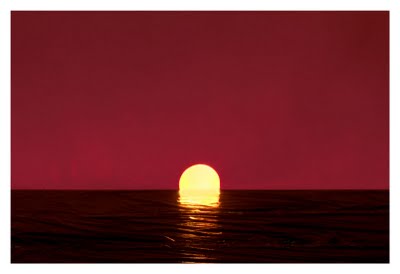
Adrien Missika
Work from Standing Waves and Postcards.
Spend time on his website, the vast majority of his works are excellent.
“Notions of authenticity and artificial images are at the heart of Missikaʼs work. He subtly explores the relationship between the viewer and the world and depictions thereof. While his works reflect the visual symbolism of the media and popular culture, he is also clearly influenced by art history and the history of photography and by their manifestations in contemporary photography. This is hardly surprising, given that Missika finds inspiration for his landscape images from sources as diverse as comics and fantasy films, postcards and magazines, art history and natural sciences like geology and archaeology. As a result, his art oscillates between fiction and reality. Missika repeatedly mixes photographs taken on his many travels with the staged photographs that he takes in his studio and with material he finds in magazines or on the internet. Although he trained as a photographer and is a true master of his art, he is primarily interested in pictures as the formal outcomes of ideas that lead him through a wide variety of media. Missika believes that every picture on display is a constructed internal landscape, an espace mentale. Missikaʼs postcard motifs depict “archetypal” subjects: a sunset, a mysterious cave, a craggy peak emerging from a sea of clouds, a mountain range. They awaken memories of things we have seen or experienced before – we are all familiar with the beguiling images from postcards that we have sent or received from all over the world. Missikaʼs work explores imagination and reality: Is paradise a perfect thing in our imagination, something that reality fails to live up to? Or is it precisely the opposite – is any attempt to capture the beauty of a breathtaking landscape doomed to failure? Some of Missikaʼs pictures reveal similarities to historical paintings such as Chalk Cliffs on Rügen by Caspar David Friedrich, which is on display at the nearby Museum Oskar Reinhart am Stadtgarten.
Yet Missika builds up this sense of romanticism only to destroy it immediately, revealing it as nothing but a sham. The postcards may play with our perceptions, but somehow they prevent the illusion from evaporating entirely – even once the viewer realises that the sea of clouds is actually made of cotton wool, a remnant of the romance of a mountain peak lingers. The way these “images of nature” work is so simple it is almost funny: Viewers recognise their own desire to surrender to the illusion yet see through this desire just moments later. Missika presents us with mirages. His craggy peaks tower over cotton-wool clouds and his mountain ranges are made of folded plastic film. The illusion is short-lived – it lasts only as long as it takes us to work out what exactly we are seeing. Missika uses this technique to reflect on the superficial treatment of visual material in this day and age and on the flood of images we are confronted with in our daily lives.” – Alexandra Blättler
Tags: authenticity, collage, conceptual, false, french, postcard, recreation, romantic, swiss
Posted in authenticity, collage, conceptual, false, french, postcard, recreation, romantic, swiss | No Comments »
Monday, 26 October 2009


The Extreme and Mean Ratio of (Head of Man)
-A shot at a public sculpture
A found bronze bust of an unidentified person is installed in the exhibition.
Before the opening its head is severed from its neck and thrown in
the sea near by. In the event that the head reappears during a show
the curator can choose to claim it and restore the bust.

Framing The Title of the Work
A studio shot of an artwork is framed. When documented during exhibition, a copy of this
photograph replaces the previous one in the frame.

Non Finito
A sculpture in process is to be exhibited or sold on the agreement that the artist might or might not turn up at the exhibition or collector’s storage to continue working on it.
__________________________________________
Nina Beier
Work from her oeuvre.
“Both the conceptual and concrete works of Nina Beier are often carried by some sort of relativism, that on the one hand can be seen as an aspect of the works conditional existence and potential of realisation [sic], from another is unfolding itself in relation to the viewer and the frames within which the works are presented.
This as site-specific installations or interventions that throws an examining glance at the institutional context. The works often appear like suggestions or guidance, whose potential for a realisation is handed over to the viewer (incl. the gallery’s staff or curator). In other cases the work presents itself as un-fulfilled promises, whose existence depend on either the viewer, the collector or maybe as a future coincidence.” – text via Proyectos Monclova
via Vvork
Tags: comceptual, danish, imaginary, incomplete, mental, meta-art, participation, performance, photo sculpture
Posted in comceptual, danish, imaginary, incomplete, mental, meta-art, participation, performance, photo sculpture | No Comments »
Sunday, 25 October 2009


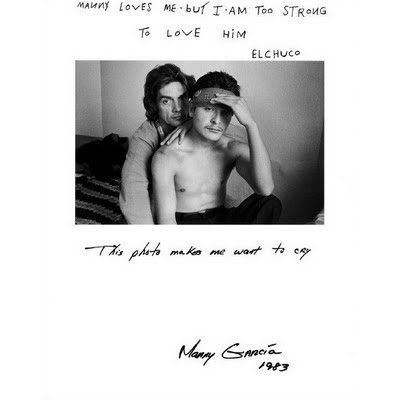
Jim Goldberg
Work from Rich and Poor.
“Rich and Poor confronts the myth of the American dream with the harsh economic reality of the American class system. Yet this documentary is more complex than that, for by including the protagonists’ voices in the form of text on his images Goldberg represents not just the polarity of class but the particularity of human experience.
Intimate portraits taken in private spaces these pictures could only have been produced with a level of trust built up over time. Goldberg was invited into his subjects’ homes, and in some cases their bedrooms, and whether or not their gaze meets the camera, the addition of their handwritten text offers us a glimpse not just into their lives, but into their psyches. Each black-and-white picture portrays an individual from one of the two economic groups often with a member or members of their immediate family. The individual narratives are hugely compelling. On a portrait of an evidently affluent older couple, the man has written words almost devoid of emotion: ”My wife is acceptable. Our relationship is satisfactory.” She observes that he is ”a private person who is not demonstrative of his affection” and that ”I accept him as he is.” Despite the evident material comforts, one would find it hard to view this as a happy marriage. In another, taken in a simple, slightly dirty room, the words on the portrait of a shirtless, bearded, man and his small son read: ”I love David. But he is too fragile for a rough father like me.” An equally simple statement, but one dense with emotion.
More exposing than a nude portrait, Goldberg’s approach is however essentially collaborative – not a relinquishing of authorship (these texts are still the result of the photographer’s carefully formulated questioning) but an attempt to solve the problem of creating a balanced documentary. Goldberg confounds simplistic stereotypes of rich or poor by engaging the viewer with their essential humanity.” – via Magnum
Tags: american culture, black and white, classic, humor, magnum
Posted in american culture, black and white, classic, humor, magnum, text, west coast | No Comments »
Saturday, 24 October 2009


Nikki Graziano
Work from Found Functions.
“For centuries, the arts and sciences/maths, have been at each others throats in regards to whose field is more relevant. Although I’m a strong supporter and believer in the arts, I’m also greatly fascinated with science and the endless theories it has to offer. I also think that they complement each other, bringing about strong potential to create and innovate, thus leaving me with no one favorite/preference.
Despite that age old feud, New York photographer and mathematician, Nikki Graziano, has combined the two worlds in a rather simplistic and beautiful manner. Photographing the mundane, Nikki extracts the organically occurring functions found in and around nature. Graphing the linear paths of shadows, trees, hills, etc, she’s able to present and produce complex equations to match the respective findings.” – Wesley Yendrys
Tags: american, blogged, math, nature, observational, rit, rochester
Posted in american, blogged, math, nature, observational, rit, rochester | No Comments »
Friday, 23 October 2009
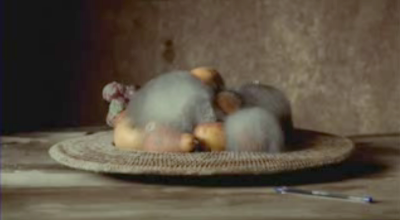
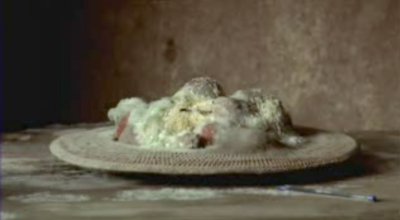

Sam Taylor Wood
Stills from Still Life.
“Still Life is one of the most classical works of contemporary art I know. It inscribes itself in art history with hardly any commentary. This is not just a Still Life. It is a vanitas, a particular type of still life developed in the 16th and 17th centuries in the Flanders and Netherlands. Its specificity was the showing of the vanity of the worldly things through often subtle signs of elapsing time and decay. Some of the vanitas had obvious references like skulls, but others yet had simply a watch, or a slightly rotting fruit. Sam Taylor-Wood’s work is another step in that direction: the image, beautiful as ever in Taylor-Wood’s universe, decomposes itself. By the end, nothing is left but a grey amorphous mass. On closer inspection, one thing distinguishes this picture from its predecessors. The ball-point pen. A cheap, contemporary object. One that doesn’t seem to decay. That is not part of the universal, self-disappearing life. Is it here to stay? This nothingness, this ridiculous signature of us? This is a poor vanitas. We are more accustomed to rich interiors with gold and crystal. But we don’t need more: we got the point. And nothing more is necessary. A simple basket, some light. Time. And a cheap pen. Oh, and lest I forget: an extremely good camera, top of the line, to catch this delicate, beautiful insurgence of death. ” – text via Ubuweb
Tags: british, conceptual, death, decay, dutch masters, meta-art, oil painting, realism
Posted in british, conceptual, death, decay, dutch masters, meta-art, oil painting, realism, video | No Comments »
Thursday, 22 October 2009


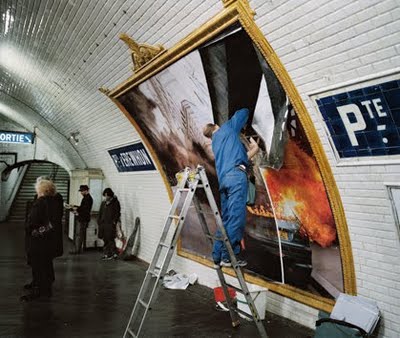

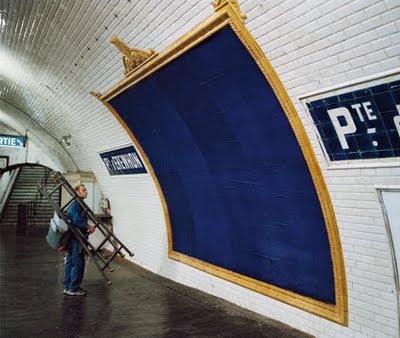
Eric Baudelaire
Stills from Sugar Water.
I also recommend Site Displacement.
“… Henri Bergson, who didn’t care much for cinema, wrote in “Creative Evolution” that in order to have an authentic intuition of duration, one had to experience it, and he took the example of sugar in a glass of water. The lesson seemed clear: “I must wait for the sugar to dissolve;” it is in the experience of vision and waiting, when my duration blends with that of the world, that the intuition of a moving reality emerges. But how does one learn to wait in a modern world that seems to be a constant flux of continuous images, yet never ceases to extract stopped images, obsessive images, and then projects these fixed images into what seems to be a perpetual cycle? “Sugar Water” can in a sense be seen as a vast metaphor of the days that followed September 11th experienced like a challenge to Bergson’s edict: the same fixed images, almost like advertisements, constantly cycling in the very heart of our daily lives, until they produce a perfect misunderstanding: we wait to see the moment where the car explodes, while the “real people” in the film (for the most part) simply await the metro and don’t see anything at all. But it can also be read as something else entirely: the daily nature of violence, of advertising, devoid of subject, void of significance, with the same PA announcements and the same barely audible song that create the rhythm of the sound track, in a cycle that mirrors the sequence of images overlapping on top of the blue monochrome of a billboard frame. How does the time spent waiting for the next image to reveal itself become something else than a repetitive old tune? Here, a sort of portrait of the artist as a billposter.” – On the Communication of Events by Pierre Zaoui
Tags: conceptual, film, installation, meta-art, performance, public
Posted in conceptual, film, installation, meta-art, performance, public, video | No Comments »


